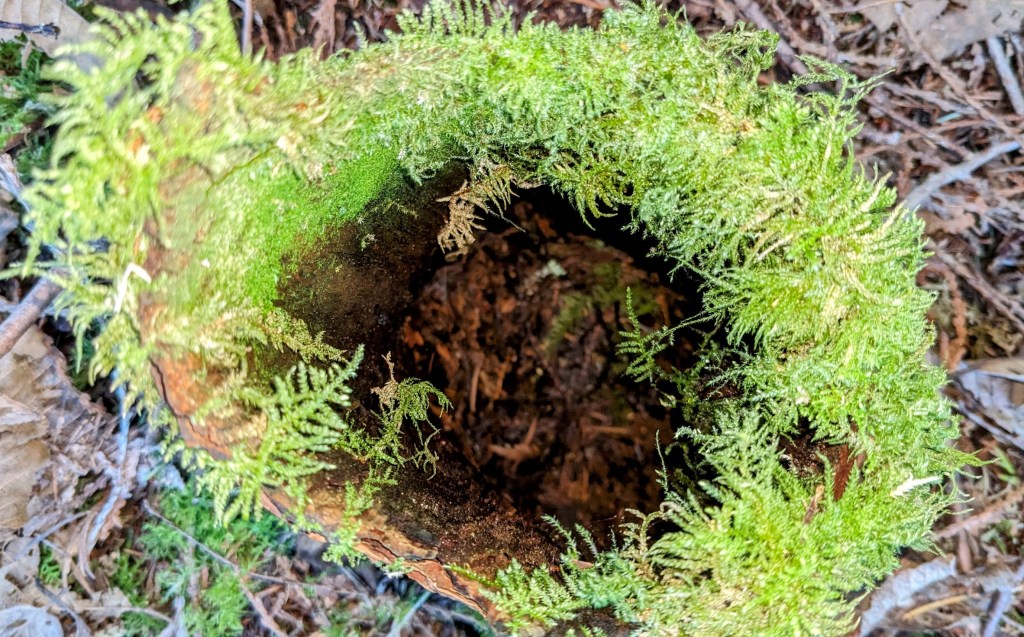
Frankenberry Farm is 10 acres of undeveloped land that I purchased in February, 2024, located 4 miles west of the Southworth ferry terminal.
Frequently Asked Question
What are you going to do with it?
This is the question that’s invariably asked in response to the “About” above. It’s the question I’d ask if someone told me they had recently bought land. The underlying question is “Why did you buy land?” with a basic assumption that the first answer is “To do _____ to it”. It’s a pretty basic and usually safe assumption, but one that I’m increasingly aware of and curious about.
So, putting that assumption aside for now, let me answer the question: Why did I buy this land?
I live with my partner in a relatively small 1 bedroom co-op (condo, if you don’t know what a co-op is) in Seattle’s Capitol Hill since 2006. I love it, and I don’t want to give it up, but I’ve been increasingly in want of some outdoor space, along with a little more indoor space, of my own. Off and on, I’ve been looking for some way to branch out my living situation for about 10 years. I’ve probably visited around 100 properties over the 10 years.
Housing in and around Seattle is expensive, and since the pandemic, many suburbs have turned exurbs and prices have risen even faster in the region surrounding the city than in the city itself. Early on in the pandemic, many of my contemporaries moved away from Seattle to somewhere outside of the city, but still in the region. Some bought a second home with which they split their time.
After being car-free for four years, I got a car in late 2020, in part to make it easier to visit my newly dispersed friends. I was also (still) looking for properties as far as 2 hours drive from Seattle as the pandemic transitioned to endemic.
I couldn’t afford anything nice enough to warrant a long drive without selling my place in the city, at least not until a lot of work was put into it. Meanwhile, having a car helped me remember how much I disliked driving.
My partner moved in with me in in the fall of 2022, and while she’s been excited about ongoing developments, she’s focused primarily on her art and not engaged in this project.
I sold my car in the summer of 2023, and began restricting my search to places I could afford without giving up my place in the city and that I could get to reasonably easy via bike and transit. This helped focus my search, and also opened up the possibility of getting something that wouldn’t be at all inhabitable for an indefinite amount of time, such as raw land. By all accounts, building something from scratch is not an undertaking for the faint of heart, but I’m not under any time constraints, and it seems like a fun and interesting project. Worst case, I cut losses and sell.
In terms of why, it was a bit of a leap of just finally doing it. This piece of land was super accessible, seemed raw and relatively undisturbed, and somehow priced 12.5% less than the county was assessing it. I walked it the day it went on the market and had an full-asking price cash offer submitted that night. Here is where the blog (the main content of this site) picks up, in the first days of 2024, in terms of recounting what I have done.
In terms of what I plan to do with it, at 10 weeks into owning the land, I still only have some vague notion to do something with it. I’d like to build a small dwelling as resilient as reasonably possible to impending climate change in a way that contributes as little as reasonably possible to the same impending crisis. Having recently finished a course in forest management for small landowners, I’m far more aware than I had been of how special it is to have land to take care of. I’m also experiencing the tension between what I’ve learned about protecting built structures against natural disasters, primarily wildfire, and everything the course taught about optimizing for biological diversity and natural habitat.
I know I do not want to clear trees to 1.5x their height away from a building site, per allowances and guidelines. This would entail clearing at least 2 acres, likely closer to 3 acres of the 10 total, which has somehow been spared logging or development for multiple generations. I don’t want to add that much to the outsized portion that humans (and our livestock) take up of the earth’s land.
I’m optimistic that there’s a way to disturb only something like 1/2 an acre of the land, and relatively minimally, with some sort of safe, efficient, responsible alternative development. I’m considering options where much of the dwelling is at least partially below grade, and the portion above grade is built from materials that would stand up well to, and be largely salvageable from, fire and tree strike. The HVAC-conditioned portion would be small (e..g 1000 sq feet or less), augmented with unconditioned, covered spaces that are “battened down” during rough weather. Eventually, other “lightweight” out-buildings would follow (art studio, greenhouse, guest tree-house) built sustainably and in a such a way that their defense need not take priority over preservation and protection of the surrounding natural habitat.
That’s where I’m at in my thinking, in early May, 2024.
 Frankenberry Farm